HMX & IRON RETRO Channels
Channels 1 and 2 each have two independent, variable analogue colour stages. Engage HMX or IRON with its switch, then use the corresponding drive control. The stages can be used separately or together on microphone, line or instrument signals.
HMX — colour stage 1
HMX uses discrete Class-A MOSFET circuitry to produce smooth, asymmetrical harmonic distortion reminiscent of valve saturation. It is voiced for strong low-frequency waveshaping and a subtle frequency-response shift similar to a tape-head bump of approximately +2.5 dB at 50 Hz.
The stage produces predominantly second-, third- and fourth-order harmonics. Its three Class-A gain stages saturate in series, with pre-emphasis and de-emphasis filtering used to increase low-frequency colouration.
The HMX control changes the amount of distortion while compensating for the level added by the drive stage. This allows A/B comparison with less loudness bias.
HMX loves bass. Try it on bass guitar, 808 and bass synth signals, during recording or mixing.
IRON — colour stage 2
IRON uses a custom-made British 1:1 600 Ω transformer driven by a discrete Class-A MOSFET network. It creates symmetrical harmonic distortion reminiscent of magnetic-tape saturation.
The magnetic core produces several related effects:
- Transient shaping caused by magnetic hysteresis, in which the core stores energy
- Low-frequency saturation as the transformer core fills with magnetic energy
- Phase shift and airy frequency-response changes caused by core resonance and damping
- Additional harmonic distortion from the Class-A MOSFET drive and gain-recovery amplifiers
IRON can add low-frequency saturation, subtly smear transients for punch, and introduce a gentle high-frequency lift from approximately 4–15 kHz before rolling off towards 30 kHz.
IRON loves transient information — feed it.
The Triangle of Tone
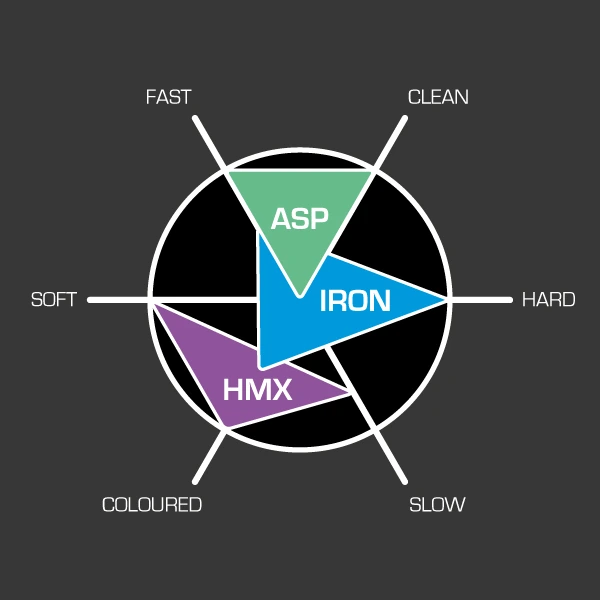
Combining HMX and IRON lets you move between thick/slow, hard/punchy and intermediate tones. The source manual suggests these starting points:
- Fat 808 drums
- Extra kick thump
- Bass guitar growl
- Acoustic guitar sparkle
- More snare attack
- Lead vocal air
Use these as listening starting points rather than fixed presets; set the drive controls by ear for the source and arrangement.