Technical Specifications & Dimensions
Microphone preamplifier
Measured to the balanced DB25 analogue outputs.
| Specification | Value |
|---|
| Microphone gain | 0–70 dB |
| Switchable pad | −15 dB, all channels |
| Line gain | −10 to 60 dB; −25 to 45 dB with pad |
| Phantom power | 48 V ±4 V at 10 mA per channel |
| Microphone EIN | <−127.0 dBu |
| CMRR | >80 dB from 100 Hz to 2 kHz |
| Maximum input level | +20 dBu; +35 dBu with pad |
| Microphone input impedance | >2 kΩ balanced; approximately 2.2 kΩ |
| Line input impedance | >8 kΩ balanced; approximately 8.6 kΩ |
| Frequency response | ±0.5 dB, 10 Hz–100 kHz at minimum gain |
| Crosstalk | <−90 dBu, 10 Hz–10 kHz |
| THD+N at 0 dBu, 1 kHz | <0.003% (−90.5 dBu), mostly third harmonic |
| SNR | >90 dB at minimum gain |
| XLR wiring | Pin 2 hot, pin 3 cold, pin 1 shield |
| 1/4-inch TRS wiring | Tip hot, ring cold, sleeve shield |
Discrete JFET D.I.
Measured through the microphone-preamplifier circuitry.
| Specification | Value |
|---|
| D.I. gain | 0 dB unity gain into the 0–70 dB preamp range |
| Maximum input level | +17 dBu |
| Input impedance | 1 MΩ unbalanced |
| Frequency response | ±0.5 dB, 10 Hz–50 kHz |
| THD+N at 0 dBu, 1 kHz | <0.01% (−80 dBu), mostly second and third harmonic |
| SNR | >85 dB at minimum gain |
| 1/4-inch TS wiring | Tip hot, sleeve shield |
Balanced analogue line outputs
| Specification | Value |
|---|
| Output circuit | Ground-sensing compensation |
| Maximum output level | +22 dBu |
| Output impedance | <200 Ω ground-sensing; <100 Ω unbalanced |
| Connector | 8-channel, 25-pin Tascam-format DB25 |
A-D converter
Measured to AES-17 without the microphone preamplifiers.
| Specification | Value |
|---|
| Chipset | Burr-Brown PCM4204, 24-bit PCM |
| Digital reference | Selectable: 0 dBFS = +18 dBu or +12 dBu |
| Frequency response | ±0.1 dB, 20 Hz to Fs/2 (Nyquist) |
| Crosstalk | <−110 dBFS at 1 kHz; <−90 dBFS at 10 kHz |
| THD+N at −1 dBFS, 1 kHz | 0.0015% (−96.5 dB) |
| THD+N at −6 dBFS, 1 kHz | 0.0009% (−101 dB) |
| Dynamic range | 113.5 dB unweighted; 116.0 dB A-weighted |
| Peak LED line-up | −2 dBFS, moves with reference level |
| Signal LED line-up | −38 dBFS, moves with reference level |
Digital output and clock
| Specification | Value |
|---|
| ADAT SMUX | 8 channels, 44.1–96 kHz |
| Clock | Internal crystal or external source |
| Word-clock input | 75 Ω BNC with switchable 75 Ω termination |
HMX MOSFET saturator
| Specification | Value |
|---|
| THD+N at 0 dBu, minimum drive, 1 kHz | 0.35%, second and third harmonic only |
| THD+N at 0 dBu, maximum drive, 1 kHz | 2.73%, dominated by second to fourth harmonics |
| Noise at minimum drive | −73 dBu, described in the source as “like an old tube amp” |
| Frequency response effect | Low-frequency emphasis from 30–150 Hz |
| Waveshaping | Asymmetrical, tube-like soft clipping |
HMX uses pre-emphasis and de-emphasis filtering and three cascaded Class-A MOSFET amplifiers. Its output level is held constant as drive changes. The source manual notes that the added noise can act as analogue dither inside a DAW.
| Specification | Value |
|---|
| THD+N at 0 dBu, minimum drive, 1 kHz | 0.11%, mostly second and third harmonic |
| THD+N at 0 dBu, maximum drive, 1 kHz | 0.006%; the source notes that it cleans up as the driver load changes |
| Low-frequency THD+N below 300 Hz | Complex variation with level and frequency; distorts bass content |
| Noise at minimum drive | −84 dBu, described in the source as “like a 2-inch tape machine” |
| Frequency response effect | Rising air boost/resonance from 4–15 kHz |
| Waveshaping | Symmetrical magnetic-loop saturation, transient shaping and phase shift |
IRON combines magnetic-core saturation with a small amount of asymmetrical saturation in its drive and recovery amplifiers. Secondary loading of the 1:1 transformer shapes the high-frequency response.
Power supply
| Specification | Value |
|---|
| Design | Low-noise, shielded linear PSU with custom transformers; fanless operation |
| Maximum consumption | 35 W |
| Internal DC rails | ±15 V, +48 V, +32 V and +9 V |
| Selectable mains voltage | 100, 120, 220 or 230 V AC |
| Fuse | T200mA for 220–250 V or T315mA for 90–120 V; time-delay slow-blow type |
Physical specifications
| Specification | Value |
|---|
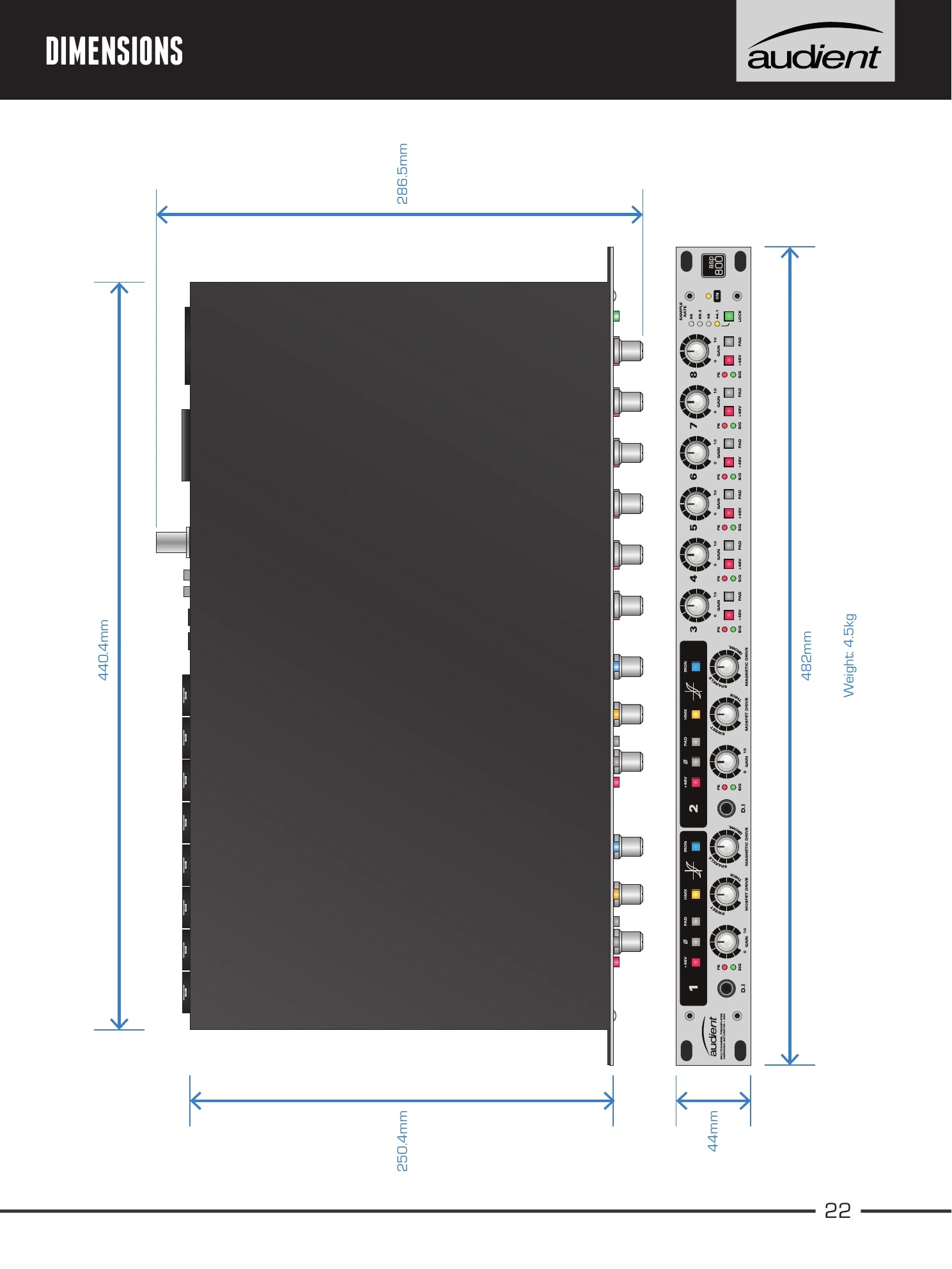
| Rack size | 1RU |
| Width | 482 mm |
| Maximum depth | 286.5 mm |
| Chassis depth shown in drawing | 250.4 mm |
| Height | 44 mm; drawing also marks 44.04 mm |
| Weight | 4.5 kg |