Foldback, Groups and Overdubbing
The use of foldback
Foldback is the means whereby a performer can hear previously recorded material and probably other current performers in order that he/she can play along in time both with them and the pre-recorded material.
Loudspeakers and headphones can be used for foldback, although in most situations headphones are the usual choice. Several problems can occur if the foldback is not giving the performer what he/she expects to hear, leading to timing and pitch variations.
The first problem is the number of available foldback mixes. If the number of performers exceeds this, an element of compromise is introduced. The second problem is creating a suitable foldback mix. Listening on headphones is a very unnatural experience for most people, and checking the foldback mix on the control-room loudspeakers or even on headphones is unlikely to sound the same as it is perceived by the performer in the studio.
Generally it has been found easier to follow a beat that is in mono. If a click track is being followed, it may pay to vary the click sound as the performer's hearing adjusts to the click and desensitizes to it. Increasing the level of the click can quickly lead to more desensitization and a need to increase the level again.
The level of the performer relative to the remaining foldback is critical. If timing is a problem, it may be that the performer is hearing too much of himself and not enough of the rest of the performers. For vocalists, pitching may be sharp if there is insufficient of themselves in the foldback and may be flat if there is too much. Pitching is usually easier with a stereo foldback mix. Too much reverberation can make pitching erratic; insufficient reverberation can lead to a lifeless performance.
Foldback in the ASP8024 can be derived from Auxiliary A and Auxiliary B. It is also possible to select the CONTROL ROOM SOURCE or the EXTERNAL INPUTS to the monitor system as foldback sources. The stereo returns can be sent to the foldback system, allowing effects to be heard by the performers.
Auxiliaries A and B are normally derived from the LF path but can be switched to take signal from the SF path. The signal is normally post fader but can be selected to be pre-fade. The foldback outputs are line-level outputs and require connection to a suitable amplifier. They are not intended to directly drive headphones or loudspeakers.
Groups and subgroups
It is the group outputs of the console that are connected to the multi-track recorder inputs. Consequently, to record anything it has to be routed to a group output.
This is done using the routing buttons at the top of the channel strip, where 12 buttons plus a SHIFT button allow routing to all 24 group outputs. The group is reached indirectly through the group mix bus, allowing one or many signals to be routed to the same group output.
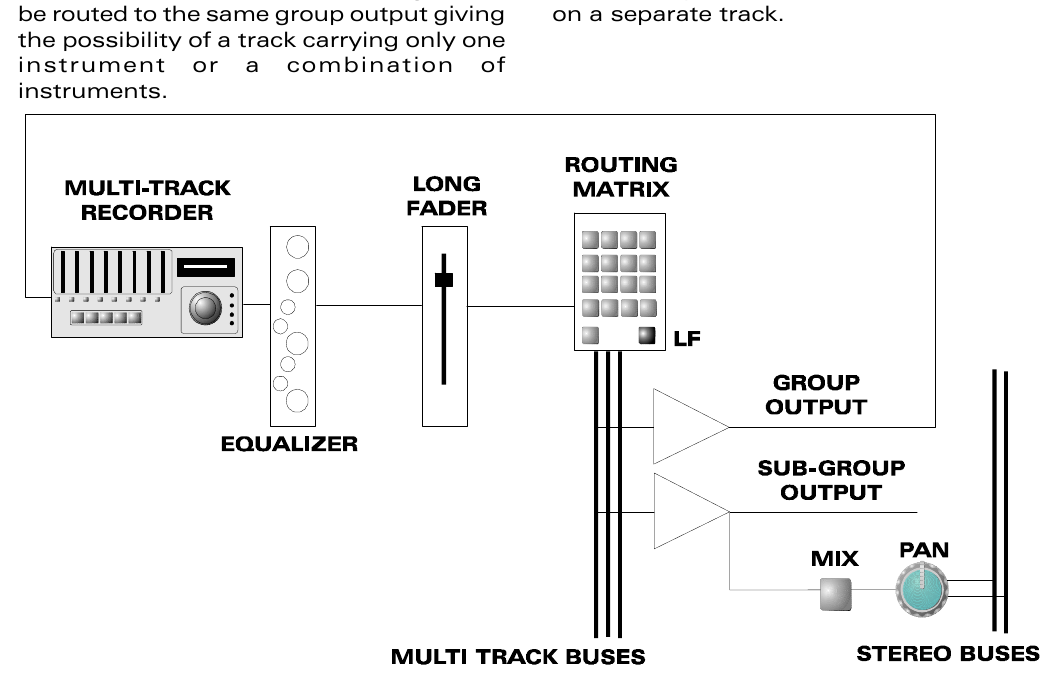
Combining instruments at the recording stage fixes the mix between them. If tracks are limited, the instruments can instead be recorded separately and bounced to another track. Route the LF path to the routing matrix on all channels to be bounced and select the same destination track for all signals. The tape is then played and the mixed signal re-recorded on the new track.
When bouncing to an adjacent track on an analogue recorder, crosstalk in the record head may cause feedback.
Bringing the signals through the console means that the equalisers can be used. Auxiliaries can send to effects, and a stereo input can return the effect to foldback or to the bounced recording.
During mixdown, especially without automation, tracks such as backing vocals can be submixed. The first eight groups are automatically assigned to eight subgroups: group 1 also routes to subgroup 1, group 2 to subgroup 2, and so on. The subgroup outputs can be used directly or assigned to the stereo mix using their MIX buttons. Up to eight subgroups can simplify the number of faders that need adjustment during mixdown.
Overdubbing
Overdubbing is a combination of tracking and mixing. The LF path brings tape playback signals to the stereo bus and to the auxiliaries for foldback. The SF path is the recording path and takes input from the studio to a track on the multi-track recorder.
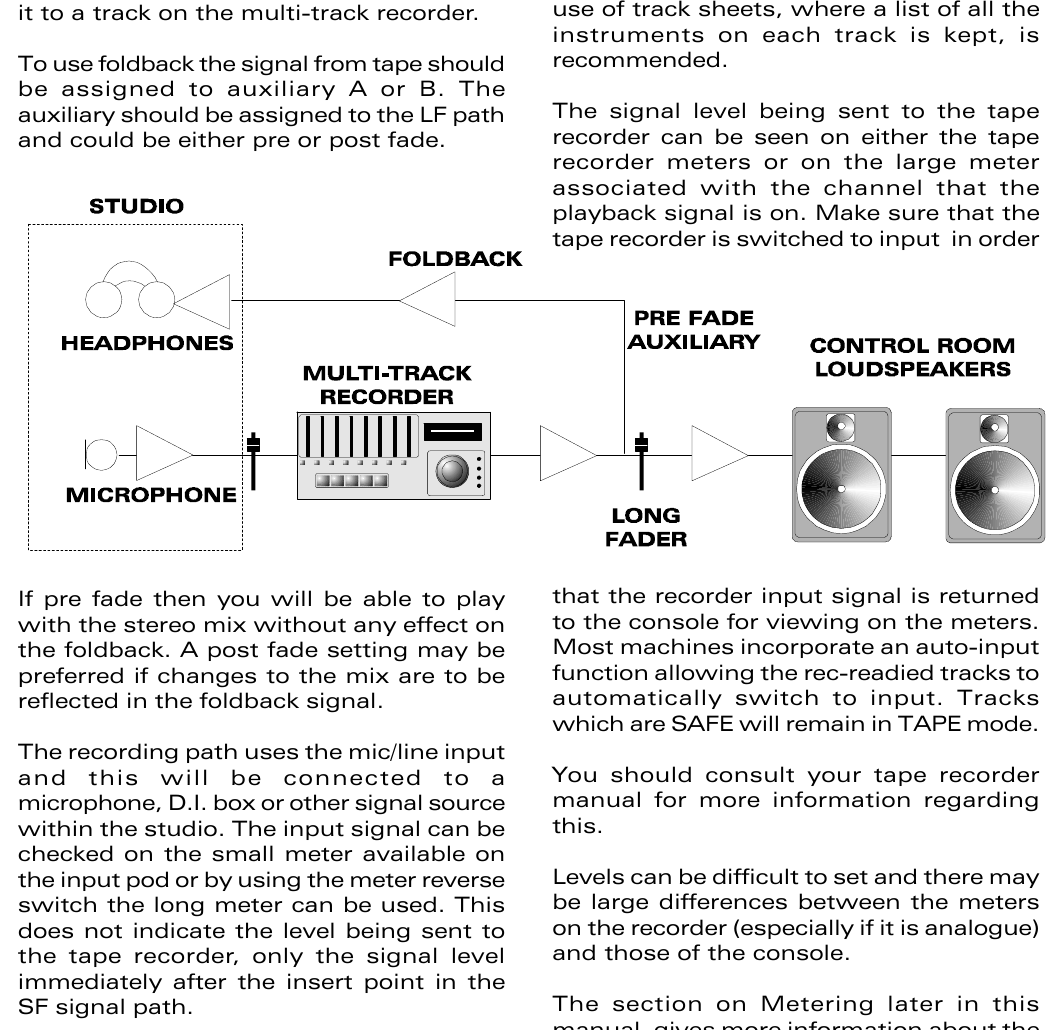
To use foldback, assign the signal from tape to Auxiliary A or B. The auxiliary should be assigned to the LF path and may be pre or post fade. Pre fade allows the stereo mix to be changed without affecting foldback; post fade can be used if mix changes should also be reflected in foldback.
The recording path uses the mic/line input. Input level can be checked on the small meter, or the meter reverse switch can place the mic/line input on the long meter. This indicates the signal level immediately after the insert point in the SF path, not the level being sent to the tape recorder. Input sensitivity should be used to establish a suitable level before the short fader.
The signal then travels through the short fader to the routing matrix, where it is assigned to the recording track. The destination track should be in REC-READY, with remaining tracks in SAFE. Be careful not to overwrite a previously recorded track. The manual recommends keeping track sheets listing the instruments on each track.
The signal level being sent to the tape recorder can be seen on the recorder meters or on the large meter associated with the channel carrying the playback signal. The recorder should be switched to input so that the recorder input is returned to the console for metering. Most machines incorporate an auto-input function; consult the recorder manual for its operation.