Metering and Connectors
Metering
Metering is extremely important as it can determine whether or not a signal is too low in level, in which case it may be noisy, or too high in level, in which case it may suffer distortion. The aim of the meters is to assist in setting the signal level between the two extremes of noise and distortion.
A signal level that is too high clips, meaning that the smooth waveform abruptly changes when the electronics runs out of headroom. If there is insufficient signal, any noise present will be amplified along with the signal when it is eventually brought up to the correct level.
The ASP8024 has input and output meters. Tape Input levels can be monitored on a 20-segment meter, while microphone input levels can be monitored on a 3-segment meter. The meter functions can be reversed, which may be useful when tracking.
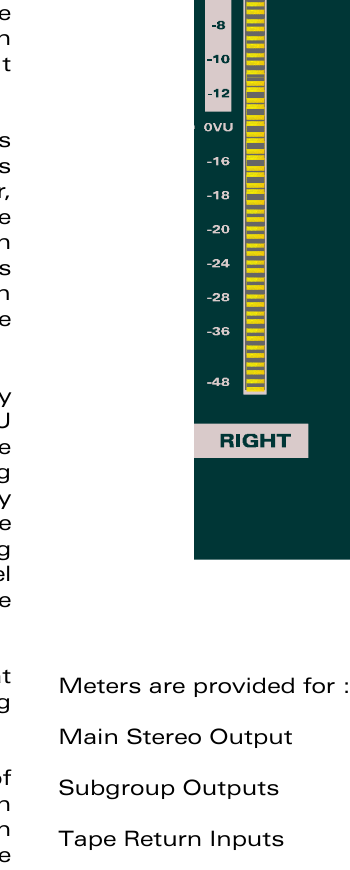
The ASP8024 peak-reading meters are intended to make comparison with digital-recorder meters simpler. The meters are calibrated with 0dBFS at the top of the scale, with other levels negative relative to this.
- 0dBFS is calibrated for a signal level of +18 dBu.
- The 0VU mark corresponds to +4 dBu.
- The OVER indicator illuminates at +20 dBu.
Meters are provided for the Main Stereo Output, Subgroup Outputs, Tape Return Inputs and MIC/LINE Inputs.
More on connectors
Jack sockets
Jack sockets are used extensively in the ASP8024. Their switching contacts allow a signal to pass through while no mating plug is inserted, but break this signal and accept the signal from the plug when it is inserted. This is known as normalling, and the signal connected through the switching contacts is the normalled signal.
The prime use of this function within the console is on the insert points. If the insert return jack has its normal contacts wired to the signal being sent to the insert send, then with no plug inserted the send signal passes through the contacts and appears on the output of the jack. This allows the insert point to remain switched into circuit when no external processor is connected.
The insert sends are ground-sensing outputs, enabling them to connect to balanced and unbalanced loads.
XLRs
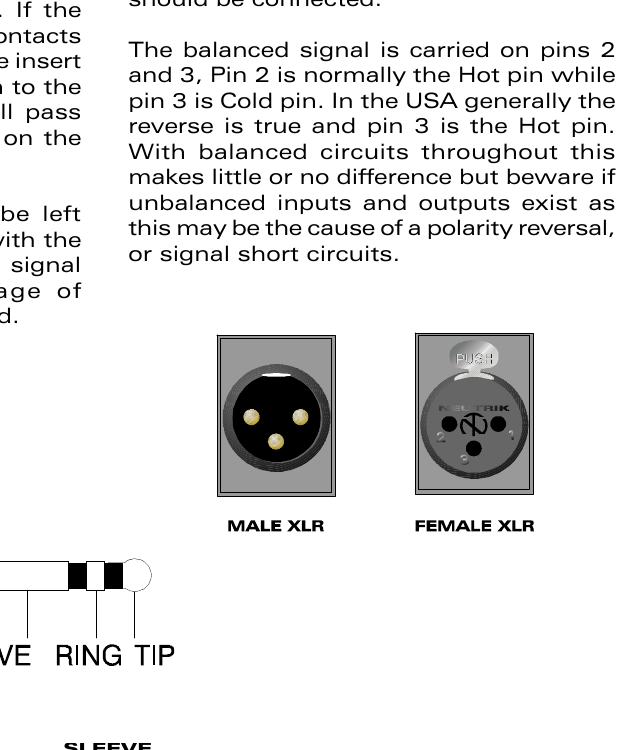
XLR connectors are found on many items of professional audio equipment. The manual describes XLR as "extra low resistance" because of the large contact area associated with the connector. Male connectors are used as outputs while female connectors are used as inputs.
There are three pins on each connector, with pin 1 used as earth or ground and connected to the cable shield. The balanced signal is carried on pins 2 and 3. On the ASP8024, Pin 2 is positive/hot and Pin 3 is negative/cold.