Master and Subgroup Metering
Master meters
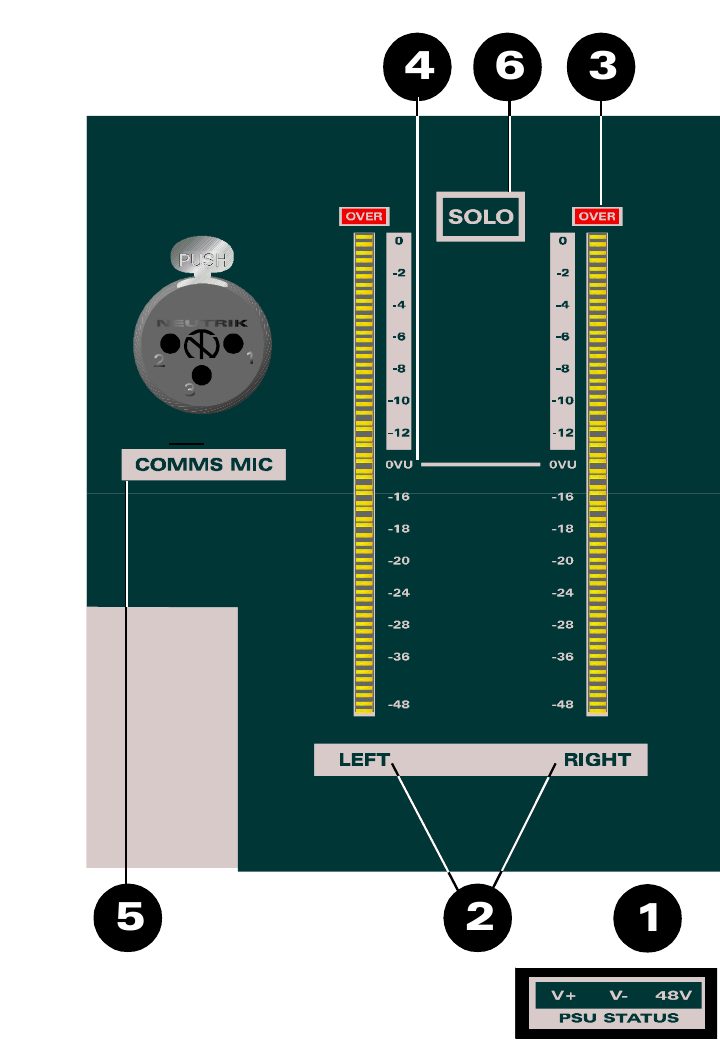
Metering is also associated with the master functions. The output meters show the output levels of the subgroups and the stereo output. If these meters show a level that is too high or too low, the original manual advises that the cause is most likely further back in the signal path; check the gain structure earlier in the path rather than treating the meter section itself as the source of the problem. See Metering and Connectors for the console's broader metering and gain-setting guidance.
- Power-supply status indicators for the +18 V, -18 V and 48 V power rails.
- Left and Right Peak Reading Main Output Meters.
- OVER indicators. A level of +20 dBu illuminates OVER. Maximum or 0dBFS is indicated at +18 dBu, corresponding to full modulation on a digital recorder.
- 0VU. A signal level of +4 dBu should illuminate the bars to this point. The meters are peak reading, so this is not described as normal operating level.
- Talkback microphone connector.
- Solo indicator.
Subgroup meters
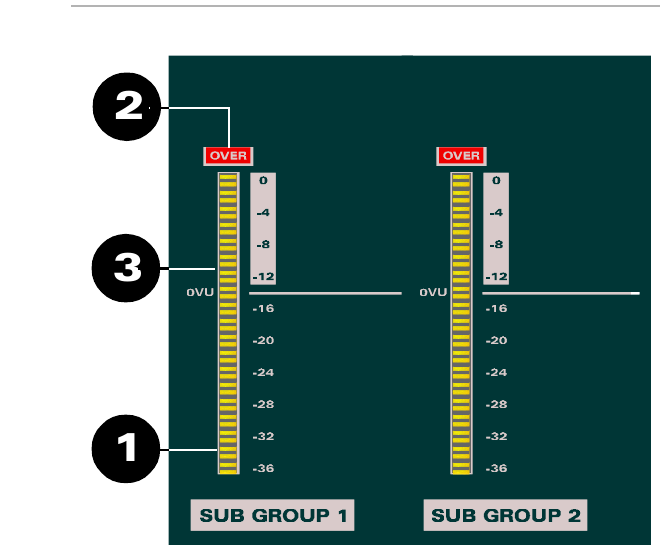
There are eight peak-reading subgroup meters, one for each subgroup output; the source illustration shows two for clarity. The OVER indicator illuminates at +20 dBu. 0dBFS is indicated at +18 dBu and 0VU at +4 dBu. As with the main meters, +4 dBu is a reference point rather than a prescribed normal operating level because these are peak-reading meters.
The first eight group buses also feed the eight subgroup outputs. The subgroups can feed the stereo mix and have their own rear-panel outputs. They can also feed an eight-track recorder directly.
During mixdown, signals on the LF path can be sent to the routing matrix and routed to groups 1 through 8, which also routes them to the corresponding subgroups. This can combine several signals under one subgroup fader for simpler mix control.