Console Layout and In-line Architecture
Console Layout
The ASP8024-HE control surface is divided into repeated input channels and a central master area. Optional modules can occupy additional buckets depending on the ordered configuration.
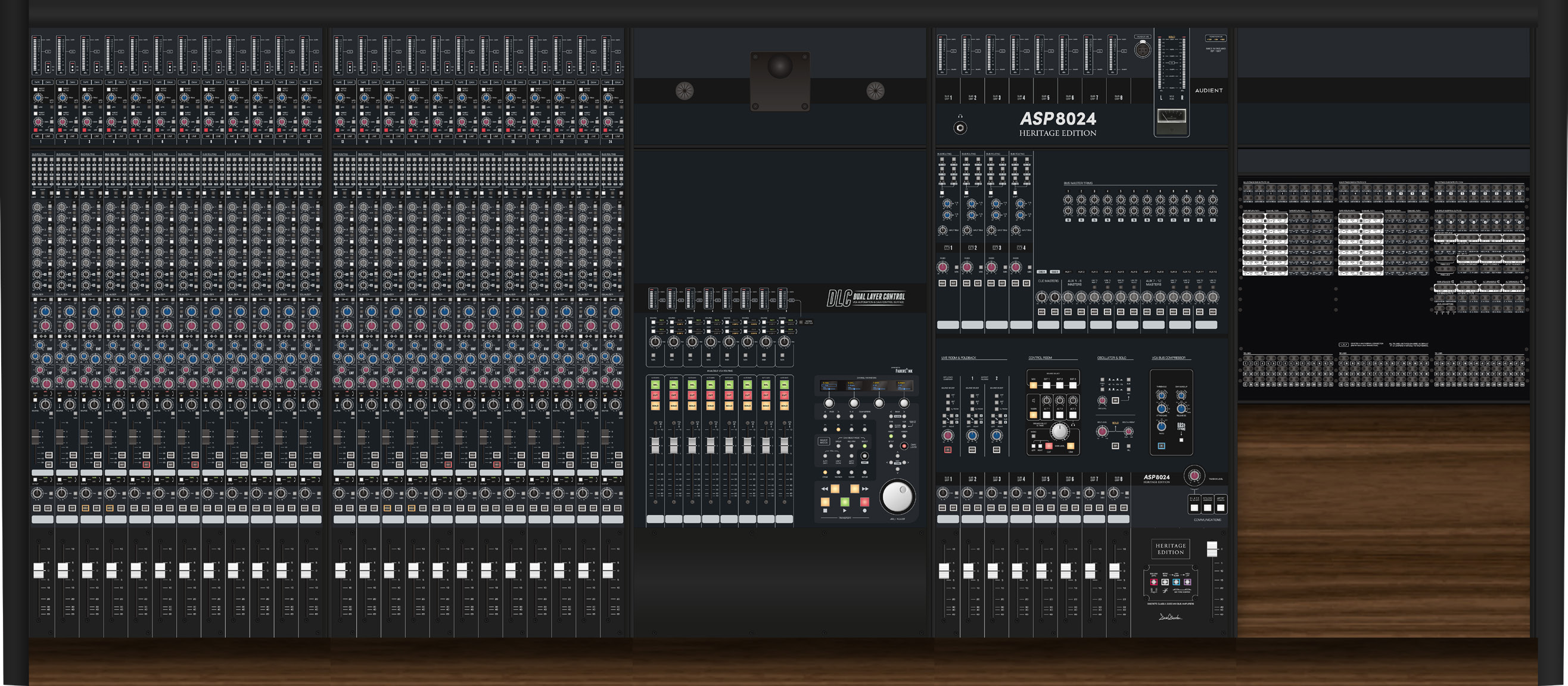
Input-channel area
Each input strip contains, from top to bottom:
- Input meters
- Mic/Line and DAW/Tape input controls
- Multitrack bus-routing matrix
- Aux and Cue sends
- Four-band EQ
- Short Fader controls
- Long Fader controls
Master area
The master section contains:
- Stereo EFX returns
- Bus master trims
- Cue and Aux masters
- Eight subgroup faders
- Heritage Output Card controls
- Stereo bus compressor
- Master fader
- Control-room monitoring
- Studio and foldback monitoring
- Talkback and communications
- Master/subgroup metering
- Oscillator and solo master functions
Optional areas
Depending on configuration, the console can also include:
- Dual Layer Control (DLC)
- On-board patchbay
- Producer's Desk / script tray
- VESA screen pod
- Cable Entry Meter Pod
- Blank pods where optional modules are not fitted
In-line Architecture
Recording typically moves through tracking, editing and mixing. ASP8024-HE uses an in-line architecture so the recording and playback paths can remain available on the same channel strip throughout those stages.
Two paths on one channel
- The Mic/Line input normally uses the Short Fader path.
- The DAW/Tape return normally uses the Long Fader path.
- CH FLIP swaps those sources.
Share channel facilities between LF and SF
The channel strip is deliberately split so different functions can serve different paths at the same time.
By default:
- Bus routing takes the SF path.
- Auxiliaries, Cue sends and EQ take the LF path.
Their local LF/SF assignment switches allow those defaults to be changed. The shelf EQ and parametric EQ sections can be assigned independently.
For example, a vocal can be recorded through the shelf EQ on SF while the DAW return on LF uses the parametric mids and a post-fader reverb send. At the same time a Cue send can take the SF input to an artist foldback mix.
This ability to split and flip the channel is what allows the console to build a monitor mix during tracking without changing the signal being recorded.
Continue to Mic and Line Inputs.