Routing, Auxiliaries and EQ
Bus routing
The routing section normally takes its signal from the SF path and sends it to the recording buses.
ASP4816-HE provides 16 bus outputs through eight routing switches plus SHIFT:
- SHIFT disengaged — buses 1–8
- SHIFT engaged — buses 9–16
Buses 1–8 also feed the eight subgroup paths.
Press PAN when using an odd/even bus pair to distribute the signal according to the channel pan control.
Press LF in the routing section to use the LF path instead of the normal SF routing source. This is useful when routing DAW returns or bouncing signals through the buses. With PAN engaged and an odd/even bus pair selected, the post-fader, post-pan LF signal is distributed across the selected buses.

Auxiliaries and cue buses
The console provides six numbered auxiliary sends plus Cue A and Cue B, giving eight auxiliary outputs in total.
For the numbered auxiliaries:
- LEVEL sets the send level.
- SF moves the source from LF to SF.
- PRE takes the selected-path signal pre-fader rather than post-fader.
Cue A and Cue B operate similarly and are intended primarily for artist foldback. They can be selected independently to the left and right sides of the Foldback outputs.
Four-band equaliser
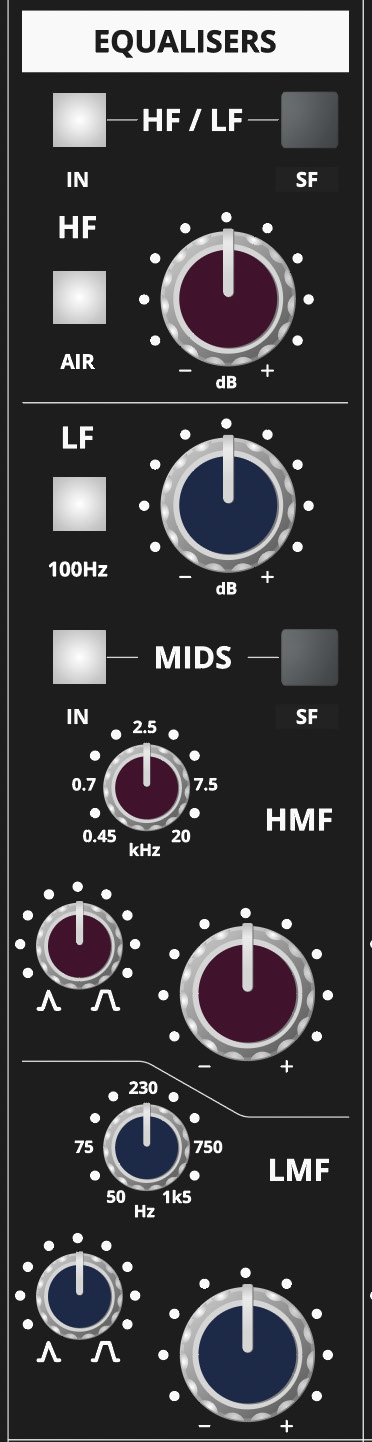
The equaliser is split into two independently switchable sections: HF/LF and MIDS. Each section has its own IN and SF control.
HF and LF shelves
- HF: ±15 dB, switchable between 10 kHz and 18 kHz using AIR.
- LF: ±15 dB, switchable between 50 Hz and 100 Hz.
Parametric mids
- HMF: ±15 dB, continuously variable from 450 Hz to 20 kHz.
- LMF: ±15 dB, continuously variable from 50 Hz to 1.5 kHz.
- Mid-band Q range: 0.65 to 3.8, approximately 2 octaves to 0.4 octave.
Move an EQ section to SF when it needs to affect the recording path. Leave it in LF when it should remain on the monitoring/mix path.
Continue to Faders and Channel Connectors.